


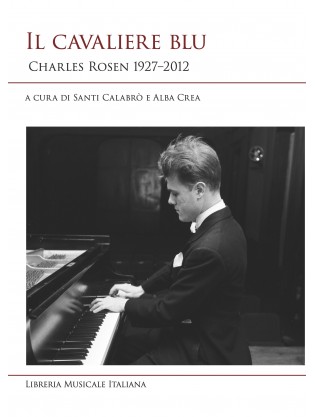
Book presentation: Charles Rosen "Il cavaliere blu" (LIM). With Santi Calabrò, Luca Ciammarughi and Roberto Prosseda
Event Details
his volume, divided into three sections — Criticism and Historical Interpretation, Form and Analysis, and Musical Interpretation — explores the wide-ranging intellectual legacy of Charles Rosen, bringing together
Event Details
his volume, divided into three sections — Criticism and Historical Interpretation, Form and Analysis, and Musical Interpretation — explores the wide-ranging intellectual legacy of Charles Rosen, bringing together scholars from different backgrounds. The contributions, collected on the tenth anniversary of the death of the great American pianist and scholar, demonstrate how his writings can still engage in a fruitful dialogue with all those concerned with music: scholars, performers, critics, and students alike.
The worldwide success of Rosen’s best-known books — above all The Classical Style, but also Sonata Forms and The Romantic Generation — has not always been matched by equally extensive scholarly investigation. The essays gathered here therefore aim not so much to celebrate Rosen as to offer a critical reassessment of his ideas, at times also from a pedagogical perspective.
What emerges is the remarkable breadth of Rosen’s cultural outlook, which provides both the foundation and the unifying principle behind the many different subjects addressed in his writings. Particularly stimulating is the critical engagement with several trends that have become prominent in musicological research over recent decades: both the New Formenlehre and Performance Studies are enriched by questioning certain commonly held assumptions through comparison with Rosen’s ideas.
Alongside reconsiderations of his best-known books, the volume also focuses on less frequently discussed essays, particularly those belonging to the later phase of Rosen’s career. Works such as Music and Sentiment and Freedom and the Arts begin here to receive the critical attention they deserve — attention which, with the exception of some significant contributions from French musicology, the international scholarly community has yet to devote to them fully.
CONTENTS
- Santi Calabrò, Introduction. Charles Rosen: Style and Ideas
- Giovanni Guanti, Crossing the Boundaries of Meaning in Music without Violating Them
- Enrico Fubini, Charles Rosen and Romanticism
- Sara Zurletti, “From the Heart — May It Return to the Heart.” Adorno, Rosen, Isotta: Once Again on the Missa solemnis
- Giuseppina La Face, Rosen’s “Romantics”: A Pedagogical Approach?
- Alba Crea, A Generation of Romantic Women. Pauline Viardot Transcribes Chopin’s Mazurkas
- Duilio D’Alfonso, From the Old to the New Formenlehre, via Charles Rosen: A Critique of Twentieth-Century Theories of Form
- Domenico Giannetta, The Evolution of a Form: Ludwig van Beethoven’s Early Piano Sonatas
- Antonio Grande, Structure and Narrative in the First Movement of Schubert’s Sonata D 845: Redrawing the Boundaries
- Santi Calabrò, The Empty Chair and the Guest of Honour: A Hermeneutics of Charles Rosen’s Thought
- Guy Cherqui, “Not Even the Most Prestigious Stage Production Could Save It…” And Yet, Director’s Theatre “Saves” La clemenza di Tito
- Letizia Michielon, The Pleasure of Analysis and the Pleasure of Interpretation in Charles Rosen. An Exemplary Case: Ludwig van Beethoven’s Sonata Op. 106
- Andrea Francesco Calabrese, “The Elegance of the Hedgehog.” Rosen’s Twofold Interpretation of the Davidsbündlertänze, Op. 6
- Roberto Prosseda, Charles Rosen as Pianist and Teacher
- Jeffrey Swann, An American Intellectual
Time
03/10/2026 11:30 - 12:00
Location
Media Lounge
Other Events