


Presentation of the book "Tartini. Genio dell'arco. Una biografia critica" by Mirko Schipilliti
Event Details
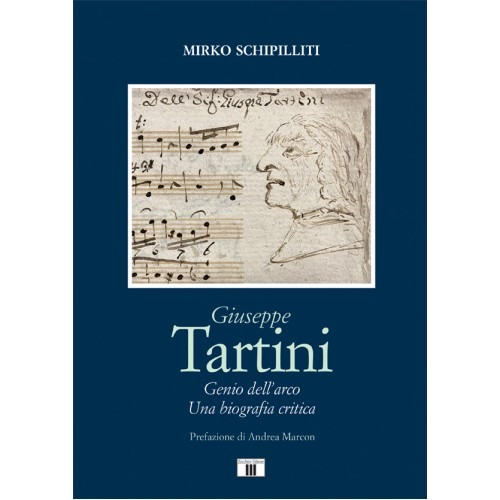
Genius of the Bow. A Critical Biography Mirko Schipilliti Giuseppe Tartini Genius of the Bow. A Critical
Event Details
Genius of the Bow. A Critical Biography
Mirko Schipilliti
Giuseppe Tartini
Genius of the Bow. A Critical Biography
Preface by Andrea Marcon
In the eighteenth century, Giuseppe Tartini (1692–1770) was the foremost violinist and one of the most celebrated musicians of his time, as well as a passionate scholar, an internationally renowned teacher, and the discoverer of the “third tone.” Described as “one of the most celebrated violinists” (Leopold Mozart), “the greatest composer of our times” (Euler), and the “Master of Nations” (Lalande), Tartini has long been surrounded by inaccuracies, myth, and legend, while many aspects of his life remain mysterious or insufficiently explored.
How did he become so famous? What is the origin of the celebrated aphorism attributed to him, “to play well, one must sing well”? His musical output, which includes numerous concertos presenting considerable technical and interpretative challenges, has yet to be published in its entirety and remains associated above all with a handful of famous works, including the Devil’s Trill Sonata.
A composer of genius who lived an extraordinary life, Tartini was both a supreme expression of his age and a forerunner of Classicism within a truly European context. Over recent decades, extensive research — often scattered across difficult-to-find publications and individual studies — has accumulated a wealth of fragmentary information, generally focusing on isolated aspects of the musician.
Eighty years after the first monograph devoted to Tartini, this book offers a faithful and coherent reconstruction of the violinist’s life and musical output. Through a comparative analysis of sources, documents, and previous scholarship, considered within their historical and cultural context and complemented by new evidence and deductions, it provides a comprehensive portrait of one of the most complex, daring, fascinating, and enigmatic musical figures of the entire eighteenth century.
“Such is Tartini’s music to me,” wrote Blainville: “a true language of sounds, musical phrases founded on the purest melody and on the art of making the violin sing.”
Contents
Preface by Andrea Marcon
Introduction
- Pirano (1692–1708)
A Pleasant Land on a Varied Sea and Noble Stage – The Famous Salt Pans of Pirano – A Devout Family – A Humanistic Education – A Rebellious Young Man
- Padua (1708–1710)
At the University – Time for a Change – A Marriage That Was Not Meant to Be
- Travelling (1710–1715)
An Extremely Arduous Life – Assisi – An Immortal Dream – Ancona I – La fede tradita e vendicata – The Third Tone
- In Search of a Position (1715–1721)
In the Orchestra – Returning Home? – An Unforgettable Academy – A Duel? – Ancona II
- Return to Padua (1721–1723)
First Violin and Concertmaster – The Antonian Musical Chapel – The Kapellmeister – A Keen Observer – Illustrious Colleagues
- Prague Beyond Prague (1723–1726)
Vandini’s Departure – The Italians and Europe – A Memorable Coronation – Tartini in Prague – One of the Greatest Violinists – A Position in Prague – Musical Life in Bohemia – Life in Prague – The First Compositions – A Less Than Fruitful Stay
- Developments and New Contacts (1726–1730)
Return to the Santo – The School of Nations – Parma – The Concertos, Op. 1 – Questions of Temperament
- Padua Forever (1730–1739)
Offers from England – The Sonatas, Op. 1 – Tartini’s Mottos – Giovanni Battista Martini – Activities Outside the Institution – A Famous Oboist – The Concertos, Op. 2 – A Gentle and Amiable Violinist
- Questions of Style (1739–1740)
Tartini’s Three Periods – The Second Period – To Play Well, One Needs a Method – The Traité des Agrémens – Leopold Mozart, Too – The Regole
- Unexpected Events and Decisions (1740–1746)
A Serious Health Problem – Venice – The Sonatas, Op. 2 – Gian Rinaldo Carli – The Family
- Success and Its Fruits (1746–1754)
Francesco Algarotti – Six Violins for Dresden – Always Supporting One’s Pupils – Music for Frederick II – The Flute Concertos and the Little Sonatas – The Devil’s Trill – Trio Sonatas – Violin Concertos in the Netherlands and Germany
- Mathematics Is Not a Matter of Opinion (1754)
The Genesis of the Trattato di musica – The Debate with Padre Martini – Subjects and Principles of the Trattato di musica – Reactions to the Trattato di musica – What Remains of the Trattato di musica
- The Art of the Violin (1754–1761)
European Recognition – From Germany and Beyond – Giordano Riccati – The Mature Style and the Last Sonatas – Among the Final Violin Concertos – The Cello Concertos and Viola da Gamba Sonatas – L’Arte dell’arco – A Fundamental Letter – Technique upon Technique
- In Memoriam (1761–1770)
A Portrait for Everyone – Metamorfosi – The Sonatas for Four – The Last Pupils and Visitors – De’ principj dell’armonia musicale – A Spiritual Testament – Glory to God – The Will – An Eternal Message
APPENDIX 1. Letter to Maddalena Lombardini
APPENDIX 2. Table of Tartini’s Mottos and Texts
APPENDIX 3. List of Violin Concertos (D.) According to the Periods Identified by Dounias
Time
03/10/2026 16:30 - 17:15
Location
Media Lounge
Other Events