


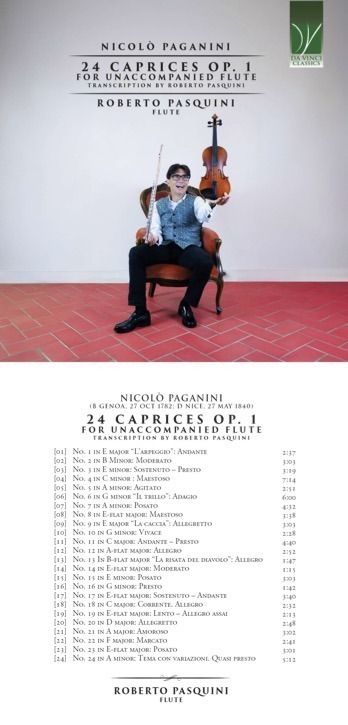
Presentation of the transcription of Paganini's 24 Caprices for solo flute (score and CD), by Roberto Pasquini
Event Details
Presentation of the transcription of Paganini’s 24 Caprices for solo flute (edition and CD), by Roberto Pasquini. Da Vinci Editions. When one
Event Details
Presentation of the transcription of Paganini’s 24 Caprices for solo flute (edition and CD), by Roberto Pasquini. Da Vinci Editions.
When one is about to tackle a monument of music history such as Niccolò Paganini’s 24 Capricci op. 1, one always trembles with the fear of not being up to the enormous task. Only daily work and love for these notes so fraught with difficulty can overcome the lump that forms in one’s throat at the mere idea of transcribing for flute the summa work of the Genoese maestro. I think, however, that the transverse flute, which began life as a delicate instrument with well-defined characteristics, has now reached a level of constructive perfection, expressive, dynamic and technical capacity that gives a new light and colour to this cornerstone of the violin repertoire. The flute sings and soars through Paganini’s flights with great agility, using both new contemporary techniques such as sing and play, multiphonics and pizzicato, and more traditional ones such as tremolos, trills and broken chords, allow the polyphonic texture of the original score to be fully restored in its crazy visionary nature, so new at the time but still a challenge of bravura and creative imagination. If I had to say which topos prevails in the long musical journey, I would speak of the heroic, who was perhaps as Paganini imagined himself, a romantic and solitary hero capable of playing like an orchestra (Capriccio No. 4), as fast as the wind (Capriccio Nos. 1, 3 and 5) or an explorer of new worlds (Capriccio No. 24), just as heroic are almost always his locks in forte at the end of each capriccio. Heroism certainly goes hand in hand with virtuosity, but it is never an end in itself and there is always room for irony (the hunt, Capriccio No. 9, the devil’s laughter, Capriccio No. 13, the bagpipe, Capriccio No. 20), melancholy (Capriccios No. 6 and No. 11) and tenderness (Capriccio No. 21). The singability typical of the great Niccolò pervades the musical expression everywhere and transcends virtuosic limits, and it is precisely in this that the flute is able to illuminate, with its sound at once warm and brilliant, the ever-changing landscape of the melodies of these beautiful caprices.
Time
26/09/2025 14:00 - 15:00
Location
Media Lounge
Other Events