by Gea Sandri
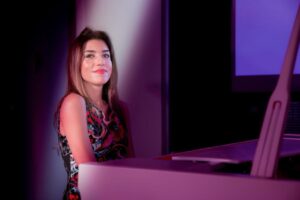
What drives a musician to leave the safety of the stage in search of real life? For Giulia Vazzoler, pianist, teacher and music critic, the answer lies in the very nature of art: an unbroken dialogue between memory, rigour and humanity.
Born in Treviso in 1987, Giulia has never seen her home country as her only horizon: a hunger for the world and her piano have taken her to the most diverse places, from the gilded stages of the Persian Gulf to the pain of forgotten lands and border zones. Her career, which combines international concert work with intense activity in music outreach, now comes together in PER ELISA. Storie di musica e di frontiera (Für Elise. Stories of music and borders), a book and album project created through a partnership between Florestano Edizioni and Alfa Music, in which music becomes a vessel for memories, suffering and rebirth. On the occasion of her participation in Cremona Musica, we talked to her about the origins and meaning of this journey.
The book opens on a private and painful threshold: the early loss of your father. What did it mean to give words to this absence?
I lost my father when I was very young, just two years old. For me it has always been an unusual kind of grief: not a wound tied to memories that fade over time, but the absence, from the very beginning, of any memory lived together. It is an absence you learn to live with, and it becomes part of who you are.
Over time, certain questions inevitably resurface: you wonder whether he would have been proud of you, what he would have thought of your choices, of your son, of your music. PER ELISA gave shape to that silence, which has now become a testament to gratitude and serenity.
At the heart of the project is Beethoven, with a fresh reading of Für Elise, far removed from any cliché. What did you want to bring back to these notes, and how did you approach Beethoven’s legacy?
Beethoven is often portrayed through the cliché of torment and fate. I believe, instead, that the most authentic and revolutionary mark of his greatness is his drive towards the light. Tension and contrast in his writing are never ends in themselves: they always herald a redemption, an opening, a vital renewal.
Even a hugely famous piece like Für Elise, so often overused as telephone hold music and in advertising, holds a lyricism and poetic freshness like no other. My interpretation comes precisely from the wish to free the melody from dusty listening habits, giving back its transparency, warmth and a sense of genuine rebirth.
The book also tells of your experience teaching at the Edward Said Palestinian Conservatory. What does it mean to teach music in a border reality like Bethlehem?
Teaching at the Edward Said Conservatory was a profound experience, and it showed me clearly that classical music is a need of the soul, not an academic luxury or a privilege for the few.
I chose to live in the heart of Bethlehem to immerse myself in the real life of the place: among the sounds and rhythms of the souq, the traditional market, everyday relationships and the disarming simplicity of shared gestures, beyond any affiliation or barrier. But the deepest exchange was with my students: curious, talented young people for whom sitting at the piano meant building an inviolable space of dignity, beauty and future. Music has an extraordinary power: it teaches us to listen to one another and breaks down any border, even before conventions have a chance to notice.
You have often said that today a performer can no longer “hide behind the instrument”. What is the responsibility of the contemporary classical musician?
For many years I told the stories of other people’s projects, working in radio, on television and on the stages of Cremona Musica, until I felt the urge to put myself on the line, with my own voice and artistic identity.
All too often classical musicians have entrenched themselves behind the supposed sacredness of the score, with a set of nineteenth-century conventions that have pushed contemporary audiences away. I believe artists must shed every formality to communicate a sincere and direct truth. Classical music cannot remain shut away in an ivory tower: it works its greatest miracle when it steps down from the stage, embraces people and makes its way through their vulnerabilities. It belongs to everyone, and it is our responsibility to make it alive, accessible and shared once again.