by Michela Ianniciello
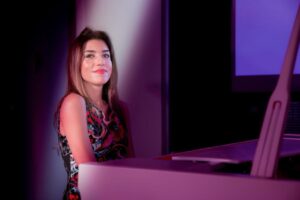
Alessandro Artese presents a journey through time from Haydn to Scriabin at Cremona Musica International Exhibitions and Festival 2025. The young twenty-four-year-old pianist, winner of the Grand Prix at the Rosario Marciano Competition in Vienna and first prize at the Massarosa International Piano Competition, arrives for the first time at the prestigious Cremona event with a program spanning nearly three centuries of music. Born and raised in Bologna, Artese earned his Master’s Degree with top marks, honors, and honorable mention from his hometown Conservatory under the guidance of Federico Nicoletta, with whom he is continuing his studies in Rovigo, and also specializing with Natalia Trull in Stradella and Benedetto Lupo in Pinerolo.
How did your first encounter with the piano happen?
There are no musicians in my family; I was the first to play an instrument. I started out playing, playing by ear the tunes I heard on television on a small keyboard my parents gave me. It was all very instinctive, pure fun, until I started studying with Valentina Berman at the age of seven: that was the starting point of my musical journey.
What are your plans for the future?
I’d like to give more concerts and share my music with audiences. Currently, I’m mostly working as a soloist, and I’d like to continue my career in this direction. I have an important challenge coming up in November: the Paderewski Competition in Poland. I’ll also try to enter other competitions, but I’d rather not say which ones… I’m a bit superstitious!
This is your first time at Cremona Musica. What have you prepared for the occasion?
I have chosen a program that begins with Haydn’s Sonata in C minor and ends with Scriabin’s Fifth Sonata, passing through Chopin’s Scherzo No. 4 and Polonaise-Fantasie, and three Études-Tableaux by Rachmaninoff from op. 33. I’d like to recount the stylistic evolution of music from the eighteenth century to the early twentieth century. The pieces I’ve chosen to open and close represent the antipodes of the sonata form: while they share similarities in structure, they develop completely divergent musical solutions. For the nineteenth century, I drew inspiration from the composer I feel closest to, Chopin. The Études-Tableaux, on the other hand, are true sound paintings that pave the way for the arrival of Scriabin’s final piece in modernity. I’m truly excited and I’m sure it will be an unforgettable experience!