by Sebastiana Ierna
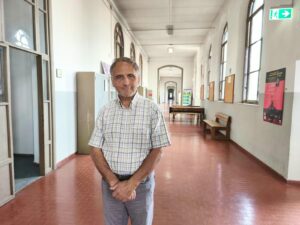
Yamaha Corporation, with its 138-year history, is a key presence on the international music scene. Thanks to constant research and development, it offers high-quality services and products, continually improving its instruments, and collaborates with renowned artists. We spoke with 45-year-old Austrian Simon Oss, from Tschagguns, who attended the latest edition of the Cremona Musica International Exhibitions and Festival. Having lived in Hamamatsu, Japan, for nearly nine years, he has been working for the Japanese company in piano sales and international relations since 2013.
Can you remind us how the Yamaha brand was born and what its peculiarities are?
It all began in 1887, when piano and pipe organ manufacturer Torakusu Yamaha founded the Nippon Gakki Company, Limited. Its current name was given to mark its centenary. The first pianos were created in 1900, and production subsequently expanded to include all musical instruments. In 2008, the Austrian company Bösendorfer was acquired, which remained independent with its artisanal manufacturing facility in Wiener Neustadt, near Vienna. Yamaha has also long had service centers around the world for professional pianists: in January 2026, one will open in Paris, where numerous acoustic pianos can be tested, including the CFX concert grand, the flagship of the current catalog. Furthermore, we have 3,250 Yamaha music schools with over 450,000 active students worldwide, employing our unique methodology, which involves a holistic and creative approach from the very first lesson.
For 40 years, your Disklavier has captivated pianists around the world, making possible what, until recently, would have seemed like pure magic. Do you recall any memorable moments?
I remember the remote masterclass held in 2020 by Cathal Breslin, associate professor of piano at the School of Music, Dance and Theatre at Arizona State University and a Yamaha Performing Artist, attended by four students in three cities in China. It was the first-ever connection of Disklavier pianos. On the creative side, I think of pianist-composer Dan Tepfer, a Yamaha artist, who incorporates algorithms, performed on the Disklavier, into his pieces. Finally, I remember Elton John’s concert in the Hyperion Theater at Disney California Adventure Park on January 25, 2013. His piano performance on the Disklavier was faithfully reproduced in real time on each remotely connected instrument, while the 60-piece orchestra could be seen and heard on adjacent monitors. An unforgettable experience, to say the least!
How do you see the future of the marriage between tradition and innovation?
I’m a traditionalist with an interest in contemporary music; at home, I have an acoustic grand piano and a Yamaha Avantgard digital piano, as well as an electric and acoustic guitar. Music is a great passion of mine, and staying abreast of the times means being able to take advantage of the latest technological advances available. One of Yamaha’s many projects worth mentioning is Dear Glenn, which uses artificial intelligence and is inspired by the unique style of the extraordinary Canadian pianist Glenn Gould, who died in 1982 at the age of 50. The system reproduces the artist’s masterful touch, offering a stimulating and interactive experience of co-creation between an AI pianist and human musicians. Ultimately, the combination of expertise, profound sensitivity, and advanced technologies leads to revolutionary experiences, enabling the development of a new and engaging musical culture.